Protective sleeves on gas pipelines, Desyonovskoye (Moscow)
Geotechnical and environmental surveys for the installation of four split casings on active trunk gas pipelines crossing the access roads of a residential development under construction in the settlement of Desyonovskoye.


Objective
We completed geotechnical and environmental surveys for the reconstruction of three high-pressure trunk gas pipeline strings (DN1000 and DN1200) from KRP-10 — installing split casings where the pipes cross the access roads of a new residential quarter in the settlement of Desyonovskoye. The client is a gas utility design organisation; the works took place in September–October 2024.
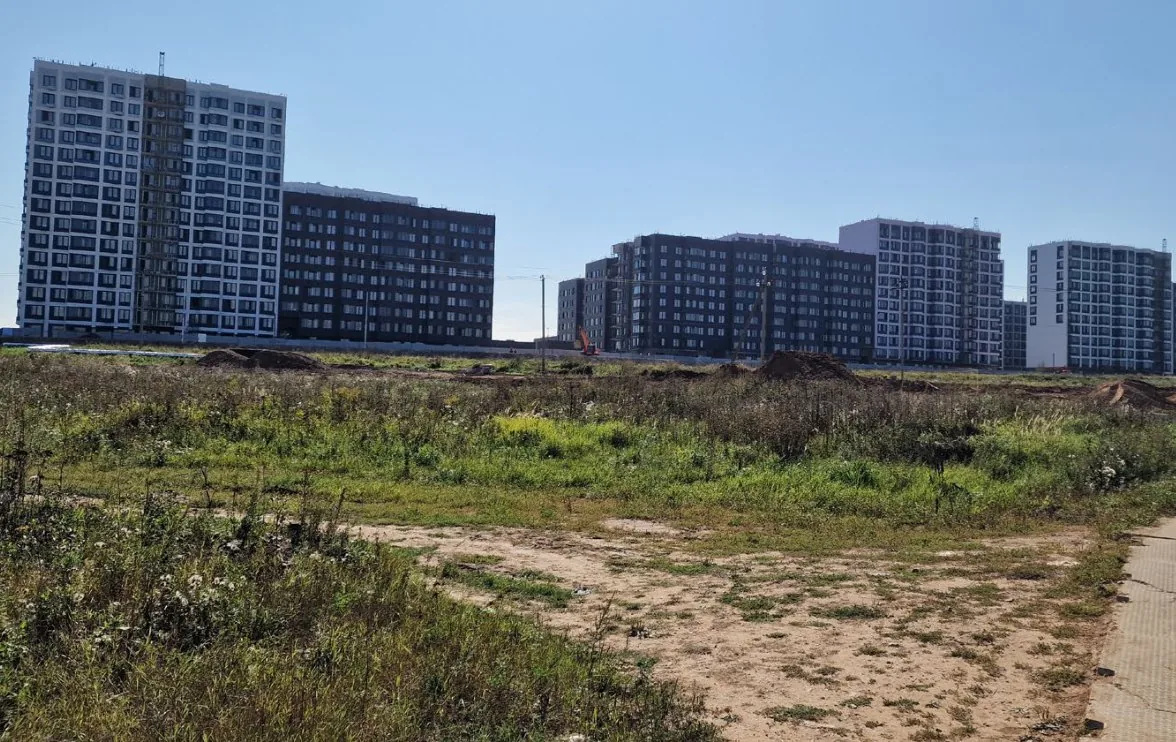
Four steel sleeves 1220 and 1420 mm in diameter and 5.65 m long each, laid at depths of 3.3–5 m, are being installed on live pipes without shutting down the gas pipelines; therefore, the geological profile had to be investigated precisely at the crossing points and the soils assessed for carriageway loads. The site is a former field adjacent to a multi-storey residential construction site, containing made ground and live utilities.
Six 10 m boreholes were drilled using a URB-2A-2 rig by core drilling with full core recovery and borehole wall casing; alongside them, cone penetration testing was carried out at six points together with two plate load tests for direct determination of the deformation modulus. Environmental engineers collected samples from depths of up to 5 m in the boreholes and performed a radiation survey.

Scope of work and deliverables
GTGeotechnical surveys
Scope of work
- 6 boreholes 10 m deep — 60 linear metres of cased 127 mm rotary core drilling
- 6 cone penetration tests (CPT) and 2 in-situ soil plate load tests
- sampling of 11 undisturbed cohesive soil cores, 10 disturbed sand samples and 3 soil samples for chemical analysis (aqueous extract)
- laboratory testing: physical properties on 21 samples, 6 oedometer consolidation and direct shear tests, soil corrosivity to steel, concrete, lead and aluminium
- hydrogeological observations in boreholes, horizontal and vertical survey control of exploratory points
Results
- Geotechnical conditions — complexity category II (medium); plot on a fluvioglacial plain with ground elevations of 155.2–160.1 m.
- Beneath a 0.2–0.5 m layer of made ground lies stiff fluvioglacial sandy clay with sand interlayers and crushed stone (EGU-1, deformation modulus 18 MPa from plate load tests) up to 8.3 m thick; from a depth of 4.4–8.5 m lies medium-dense silty sand (EGU-2, 21 MPa).
- Sporadic groundwater was encountered in three boreholes at a depth of 4.5–4.6 m within sand lenses; parts of the site are classified as waterlogged and potentially waterlogged, with perched water possible in the sandy clays down to 3 m.
- Soils are non-aggressive to concrete and moderately aggressive to carbon steel — casing pipes require anti-corrosion protection.
- Standard frost penetration depth for loams is 1.10 m, with loams in the frost zone being moderately frost-susceptible; karst sinkholes are ruled out; casing installation is recommended immediately after trench excavation.

- Layer 1 Made ground: loam with inclusions of humic soil and crushed stone (tQIV)
- EGU-1 Brown sandy clay, stiff, with frequent interbeds of medium sand and inclusions of crushed rock up to 10%, fluvioglacial (fQIIms)
- EGU-2 Silty brown sand, medium dense, low degree of saturation, fluvioglacial (fQIIms)
- Groundwater level

Legend
- geotechnical borehole, number and depth, m
- cone penetration test (CPT) point, number
- geotechnical cross-section line, number
- gas pipeline routes and proposed sleeves
ESEnvironmental surveys
Scope of work
- 12 topsoil and subsoil samples from the surface and boreholes to a depth of 5 m: heavy metals, petroleum hydrocarbons, benzo(a)pyrene; 2 samples each for microbiology and parasitology
- reconnaissance gamma survey of 1.0 ha, gamma dose rate measurement at 10 control points, 12 samples for radionuclide content
- interpretation of satellite imagery, reconnaissance survey, enquiries to regulatory authorities, schematic map of environmental conditions
Results
- Soils and ground down to 5 m fall into the 'permissible' contamination category and are 'clean' in microbiological and parasitological terms; unrestricted use is permitted.
- The radiation environment is normal: no anomalies, and soils belong to Class I by effective specific activity of radionuclides.
- The site falls within Subzones 3, 5 and 6 of the Vnukovo Airport environs — these restrictions are accounted for in the report.

Site photos
Result
The client received two technical reports for the protective casing design. Following the resolution of review comments, a positive non-state expert review conclusion was obtained.
This is just one of our projects: every year our specialists carry out surveys on 40–50 sites in Moscow, the Moscow Region, and across Russia.
Send your technical brief — we will price it the same day
If you do not have a technical brief, describe the project: site location, planned construction, and whether a design exists. We will reply with a scope of work and cost.